AlphaFold: Five years of impact
SMRTR summary
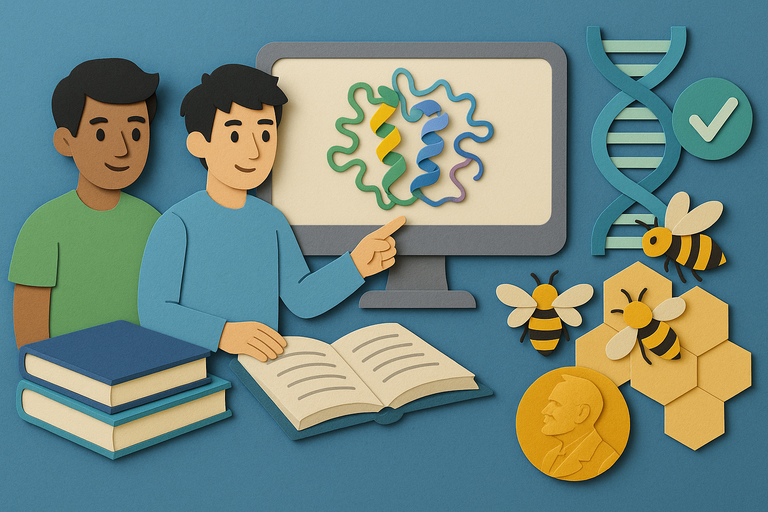
Turkish undergraduate students Alper and Taner Karagöl taught themselves structural biology during the pandemic using online tutorials, with no prior training. They've since published 15 research papers, thanks to AlphaFold, Google DeepMind's revolutionary AI system that solved protein structure prediction in 2020.
The breakthrough has transformed biological research on an unprecedented scale. AlphaFold's free database contains predictions for over 200 million protein structures and has been used by more than 3 million researchers across 190 countries, achieving what would have taken hundreds of millions of years to solve experimentally.
The impact reaches far beyond academic labs. Scientists are using AlphaFold to breed healthier honeybees by understanding key immunity proteins, while researchers finally revealed the structure of a crucial heart disease protein that had remained elusive for decades.
The work earned a Nobel Prize in Chemistry in 2024, but its real power lies in democratizing science. Research timelines have shrunk dramatically, and studies show AlphaFold users submit 40% more novel experimental protein structures than before, with their work twice as likely to be cited in clinical research.
SMRTR provides this summary for quick context. The original article belongs to Daily.dev.
Read the original article