
The world's first transatlantic fiber cable is being pulled off the ocean floor
SMRTR summary
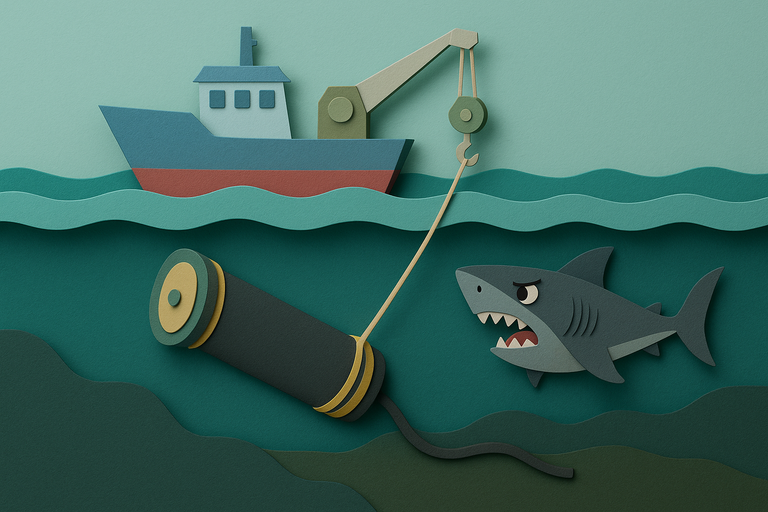
Decades after engineers first blamed sharks for chewing through undersea internet cables, specialized recovery ships are now hauling up the Atlantic's first fiber-optic system from the ocean floor, revealing the truth behind those legendary "shark attacks."
The TAT-8 cable, laid in the 1980s as the first transatlantic fiber system, is being systematically retrieved by diesel-electric vessels using nineteenth-century grappling techniques. Crews deploy flatfish hooks at one-knot speeds, following precise coordinate maps to snag segments of the 6,000-kilometer cable.
Those shark bite concerns that led to steel armor wrapping around early cables? Controlled experiments later found no evidence that electrical fields actually attracted sharks to bite cables. The incidents were likely just curious animals sampling random objects in their environment.
Now, as two-meter-long optical repeaters surface for the first time in decades, they're heading to South African recycling facilities where high-grade copper conductors and polyethylene jackets get processed back into the industrial supply chain. The copper is particularly valuable as analysts warn of tightening global supplies.
While satellite constellations grab headlines, these glass fiber networks still dominate ocean communications through superior capacity and longevity, built on the same fundamental design principles TAT-8 pioneered nearly four decades ago.
SMRTR provides this summary for quick context. The original article belongs to TechSpot.
Read the original article