
What Is the Fourier Transform?
SMRTR summary
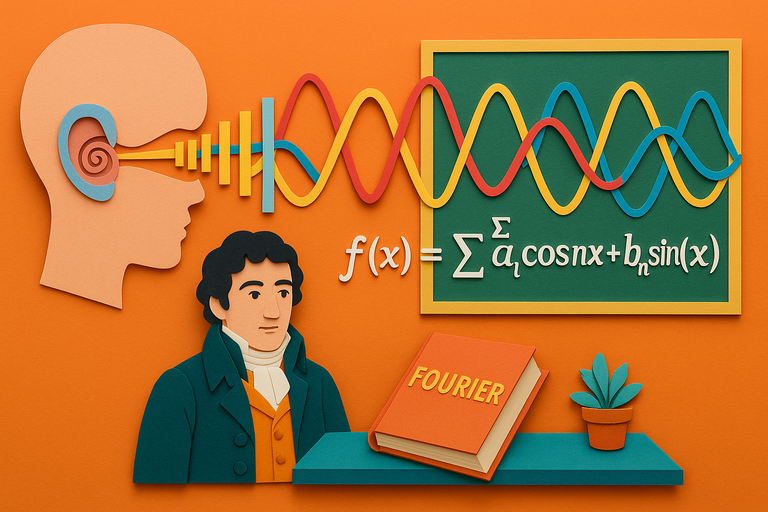
The humble cochlea in our ears performs a complex mathematical calculation that took humans until the 19th century to master. With each note of a symphony, tiny hairs separate sound waves into fundamental frequencies—a biological version of what would become one of mathematics' most transformative tools.
"It's hard to overestimate the influence of Fourier analysis in math," explains Leslie Greengard of NYU. "It touches almost every field of math and physics and chemistry and everything else."
Jean-Baptiste Joseph Fourier, a French mathematician who narrowly escaped the guillotine during the Reign of Terror, discovered that complex functions could be broken down into simpler wave components. When he presented his revolutionary idea in 1807, the esteemed mathematician Lagrange declared it "nothing short of impossible."
Today, the Fourier transform is ubiquitous. It compresses your JPEG photos, enhances audio recordings, enables MRI machines, and even explains quantum uncertainty. The technique has become essential to detecting gravitational waves, studying ocean tides, and exploring the distribution of prime numbers.
"If people didn't know about the Fourier transform, I don't know what percent of math would then disappear," says Princeton's Charles Fefferman, "but it would be a big percent."
SMRTR provides this summary for quick context. The original article belongs to Quanta Magazine.
Read the original article