
The sisters "paradox" – counter-intuitive probability
SMRTR summary
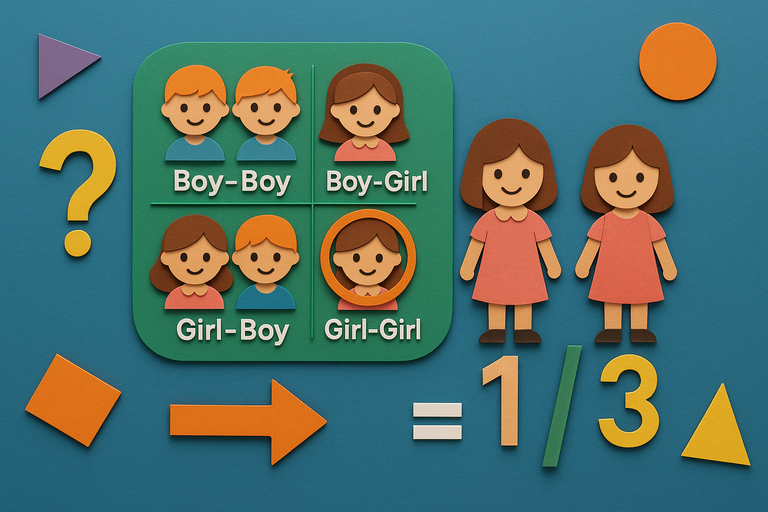
A family's two children could hold surprising mathematical mysteries. When told that at least one child is a girl, most people assume there's a 50% chance both are girls. The correct answer? Just one-third.
The math reveals why. With two children, four equally likely combinations exist: Boy-Boy, Boy-Girl, Girl-Boy, and Girl-Girl. Knowing at least one child is a girl eliminates only the Boy-Boy scenario, leaving three possibilities. Since only one of these three remaining scenarios features two girls, the probability becomes 1/3.
This "sisters paradox" demonstrates how conditional probability can defy intuition. The mistake people make is failing to recognize that boy-girl combinations appear twice (Boy-Girl and Girl-Boy), representing two-thirds of possibilities when a girl is present.
Interestingly, if told specifically that the eldest child is a girl, the probability jumps to 1/2, as this eliminates the Girl-Boy combination from consideration.
Such counterintuitive probability problems frequently appear in business contexts, where optimistic "common sense" can lead to flawed decisions unless careful analysis prevails.
SMRTR provides this summary for quick context. The original article belongs to Hacker News.
Read the original article