
The Hidden Game Theory of Sherlock Holmes
SMRTR summary
The world's most famous fictional detective, Sherlock Holmes, isn't just solving crimes - he's inspiring mathematicians. Conan Doyle's tales of Holmes and his nemesis Moriarty played a surprising role in the development of game theory.
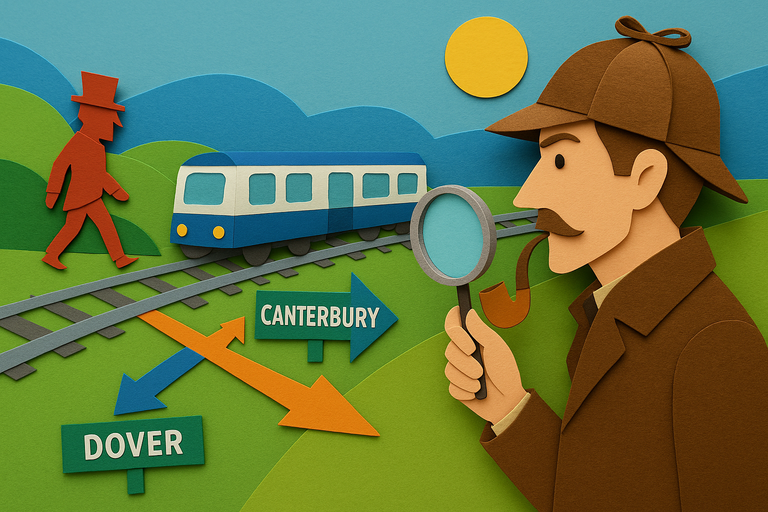
Mathematicians John von Neumann and Oskar Morgenstern were particularly intrigued by a scene from "The Final Problem," where Holmes must decide whether to disembark a train in Canterbury or continue to Dover, while Moriarty pursues him. This scenario became a classic game theory problem.
Using complex probability calculations, the mathematicians determined Holmes had a 52% chance of survival if he chose Dover 40% of the time and Canterbury 60% of the time. Remarkably, in Doyle's story - written long before game theory existed - Holmes does get off at Canterbury, evading Moriarty.
This blend of literature and mathematics shows how even fictional scenarios can illuminate real-world decision-making strategies. It's enough to make one dust off those old Sherlock Holmes books for a fresh read.
SMRTR provides this summary for quick context. The original article belongs to Scientific American.
Read the original article