
Tetris Presents Math Problems Even Computers Can’t Solve
SMRTR summary
A simple game of falling blocks has stumped even the most powerful supercomputers. Tetris, the beloved puzzle game from the 1980s, hides mathematical complexities that push the boundaries of computational theory.
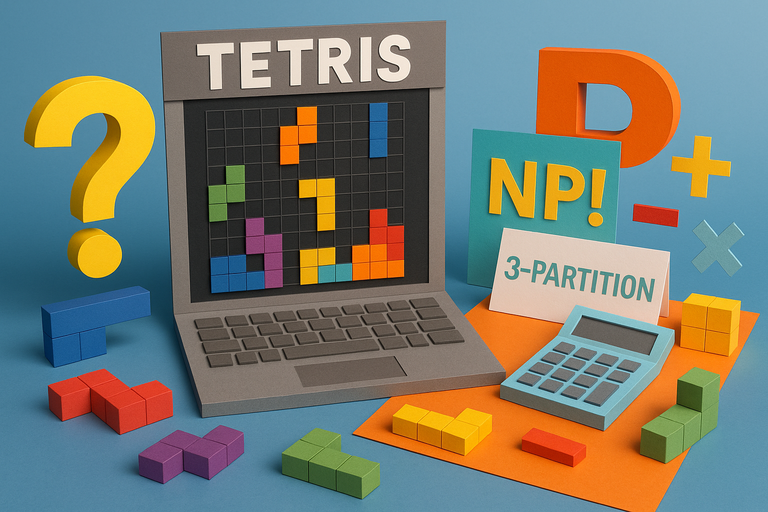
Researchers at MIT discovered that clearing a Tetris board is equivalent to solving the "three-partition problem," a notoriously difficult mathematical challenge. This places Tetris in the realm of NP-complete problems, alongside some of the most complex puzzles in computer science.
But the rabbit hole goes deeper. Dutch computer scientists found that even with infinite computing power, certain questions about Tetris gameplay are fundamentally undecidable, touching on the limits of mathematical knowledge itself.
While these insights may not help players reach the elusive level 157 (recently achieved by a 13-year-old prodigy), they reveal the surprising depth lurking beneath Tetris's deceptively simple surface. As the game continues to evolve, it remains a playground for both casual gamers and theoretical mathematicians alike.
SMRTR provides this summary for quick context. The original article belongs to Scientific American.
Read the original article