
‘Ten Martini’ Proof Uses Number Theory to Explain Quantum Fractals
SMRTR summary
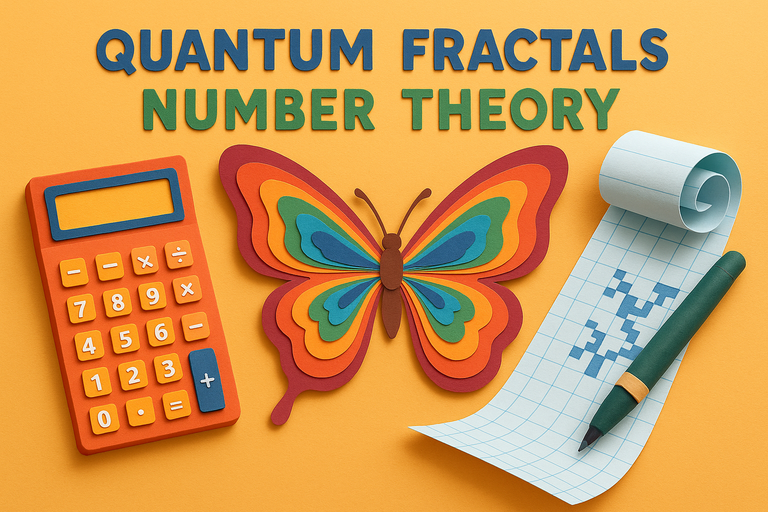
A desk calculator, a roll of graph paper, and a felt-tip pen. These humble tools helped Douglas Hofstadter uncover one of quantum physics' most mesmerizing patterns while studying in Germany in 1974.
"It was very clear to me that I had a tiger by the tail," Hofstadter recalled, despite his colleagues dismissively nicknaming his calculator "Rumpelstilzchen" and his adviser threatening to cut funding for what he considered "numerology."
What emerged from Hofstadter's calculations was a striking fractal pattern resembling butterfly wings, connecting quantum mechanics to the infinitely intricate Cantor set from number theory.
The mathematical community became so fixated on proving Hofstadter's observation that mathematician Mark Kac offered 10 martinis to anyone who could solve it. The problem remained partially unsolved for decades until 2005, when Svetlana Jitomirskaya and Artur Avila completed the proof.
But the story didn't end there. In 2013, physicists at Columbia University captured Hofstadter's butterfly in a laboratory experiment with graphene.
More recently, mathematicians have developed a unified theory that explains why these abstract patterns manifest in real-world physics, proving that seemingly esoteric mathematics can illuminate profound physical truths.
SMRTR provides this summary for quick context. The original article belongs to Quanta Magazine.
Read the original article