See how fractals forever changed math and science
SMRTR summary
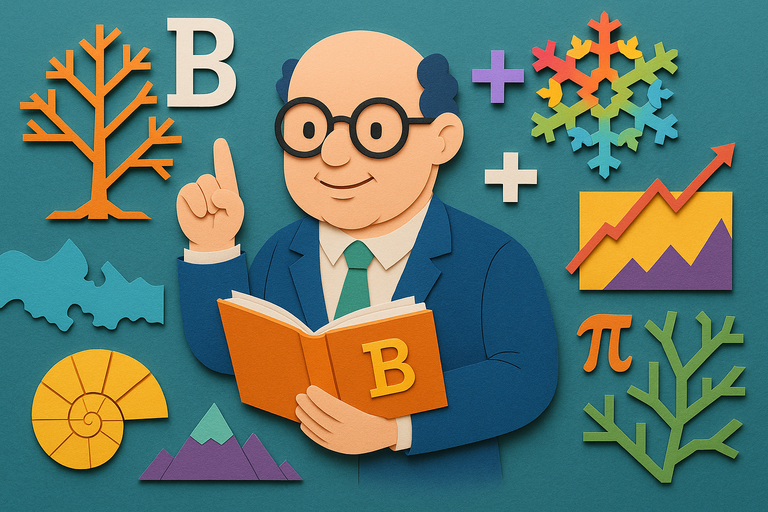
A playful quip about his middle initial revealed the mathematician's wit: Benoit B. Mandelbrot often claimed the "B" stood for "Benoit B. Mandelbrot" – creating an endless self-referential loop that perfectly embodied the concept he introduced to the world.
Fifty years ago, Mandelbrot coined the term "fractal" to describe shapes characterized by self-similarity at different scales. Think of a snowflake, where the crystal's intricate pattern repeats as it branches smaller and smaller.
"Clouds are not spheres, mountains are not cones, coastlines are not circles," Mandelbrot famously wrote, highlighting how fractals better represent nature's complexity.
These mathematical patterns appear everywhere – from blood vessel networks to financial markets, even in Bach's musical compositions.
The legacy extends beyond pure mathematics. Michel Lapidus, editor of the Journal of Fractal Geometry, uses fractals to tackle number theory's thorniest problems. Meanwhile, engineer Michael Barnsley developed fractal-based image compression that Microsoft adopted in the 1990s.
Fractals continue inspiring innovation in antenna design, signal processing, and potentially artificial intelligence – where self-similarity might someday unlock artificial consciousness.
SMRTR provides this summary for quick context. The original article belongs to Science News.
Read the original article