
Scientists use Stephen Hawking theory to propose 'black hole morsels' — strange, compact objects that could reveal new physics
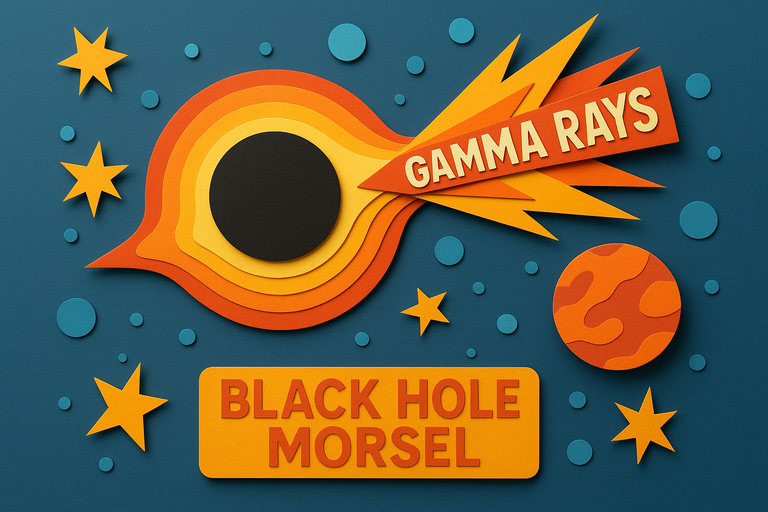
SMRTR summary
Gamma rays from tiny cosmic leftovers could unlock quantum gravity's secrets, according to an intriguing new theoretical study. These "black hole morsels," microscopic black holes formed during violent mergers of their massive counterparts, might offer physicists unprecedented access to quantum phenomena at the extreme boundaries of our understanding.
"Our work shows that if these objects are formed, their radiation might already be detectable using existing gamma-ray observatories," explains Francesco Sannino, theoretical physicist at the University of Southern Denmark.
Unlike massive black holes whose Hawking radiation is virtually undetectable, these asteroid-sized morsels would be much hotter, rapidly evaporating and releasing bursts of high-energy particles.
"Hawking radiation encodes information about the underlying quantum structure of spacetime," Sannino notes. The signals could reveal physics at energy scales far beyond what the Large Hadron Collider can achieve.
Researchers believe current instruments in Namibia, Mexico, China, and space-based telescopes might already have the sensitivity to detect these signatures - a delayed burst of gamma rays radiating in all directions.
Though unconfirmed, these cosmic morsels might provide the elusive bridge between quantum mechanics and gravity that physicists have sought for decades.
SMRTR provides this summary for quick context. The original article belongs to Live Science.
Read the original article