
'Runaway' black hole detected by the James Webb telescope adds a strange new chapter to our universe's story
SMRTR summary
A black hole hurtling through space at 3,000 kilometers per second could barrel into our solar system undetected, wreaking havoc on planetary orbits before we'd even know it was coming. While that scenario remains astronomically unlikely, recent discoveries have revealed that runaway supermassive black holes are very real and currently tearing through distant galaxies at breakneck speeds.
The phenomenon traces back to Einstein's equations and decades of theoretical work showing that when two spinning black holes collide, they can rocket away like cosmic bullets at thousands of kilometers per second. What was once purely theoretical became observable reality when gravitational wave detectors began catching these cosmic crashes in 2015.
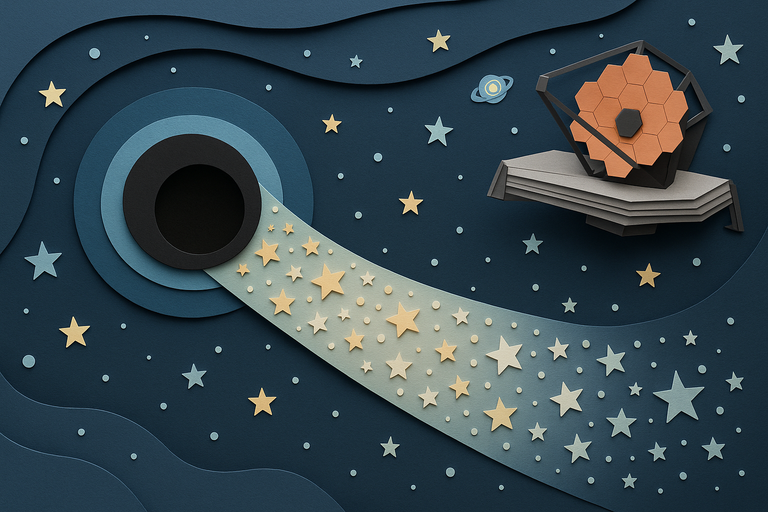
Now astronomers have spotted the smoking guns: enormous contrails of newly formed stars stretching hundreds of thousands of light years across galaxies. The James Webb telescope recently captured one such streak, created by a runaway black hole 10 million times the mass of our Sun, blazing through space at nearly 1,000 kilometers per second and leaving a wake of stellar formation behind it.
SMRTR provides this summary for quick context. The original article belongs to Live Science.
Read the original article