
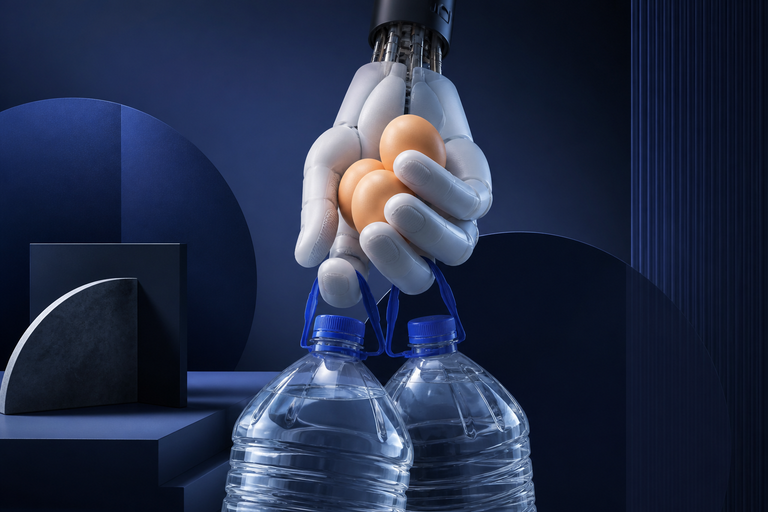
New soft robotic hand gently grips fragile eggs while lifting heavy water bottles
SMRTR summary
A robotic hand that can cradle a raw egg without cracking the shell sounds like science fiction. But Korean researchers have made it real, and the secret lies in an unexpected partnership between chemistry and artificial intelligence.
Scientists at KAIST, working with partner institutions, used machine learning to crack one of 3D printing's most stubborn problems: how to create materials that are both stretchy and printable. Highly elastic resins tend to be too thick to flow through printers cleanly, but thinning them out makes the final product brittle. The AI found the sweet spot, producing a material that stretches to over six times its original length without tearing.
The result is a soft robotic hand built from air-filled structures that curl like human fingers when pressurized, adapting its grip to objects as different as glass bottles and fragile eggs.
As Professor Seungchul Lee put it, "combining researchers' experimental data with artificial intelligence can efficiently identify optimal material combinations that were previously difficult to find."
SMRTR provides this summary for quick context. The original article belongs to Interesting Engineering.
Read the original article