
How Fat Is Schrödinger's Cat?
SMRTR summary
Scientists have successfully created quantum "cats" so large they can be seen with the naked eye, pushing the boundaries of one of physics' most famous thought experiments into the macroscopic world.
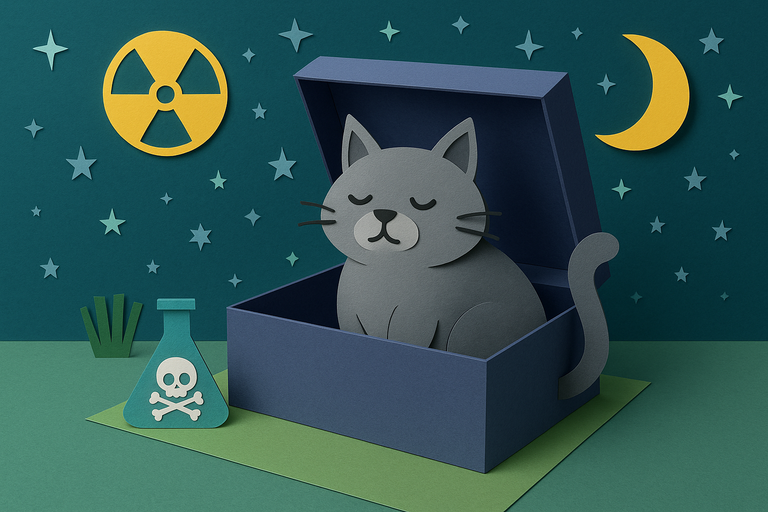
Erwin Schrödinger devised his famous cat paradox in 1935 to ridicule quantum mechanics' Copenhagen interpretation, which suggested particles could exist in multiple states simultaneously until observed. His hypothetical cat, trapped in a box with a radioactive trigger, would theoretically be both alive and dead until someone looked inside.
What Schrödinger intended as criticism became scientific gospel. Researchers have spent decades making increasingly larger quantum "cats," starting with single electrons in 1974 and progressing to trapped ions, soccer ball-shaped molecules, and massive metal clusters.
The breakthrough came in 2023 when Swiss scientists at ETH Zurich created a quantum superposition using a 16-microgram disc containing 10 trillion atoms. Though it maintained its quantum state for only 40 microseconds before environmental interference collapsed it, the disc was large enough to see without magnification.
Most recently, researchers achieved quantum interference with 7,000-atom sodium clusters, raising possibilities for biological quantum experiments with viruses or even living bacteria, while advancing quantum computing capabilities.
SMRTR provides this summary for quick context. The original article belongs to Hacker News.
Read the original article