
Einstein’s relativity meets quantum tech in experiments on space-time curvature
SMRTR summary
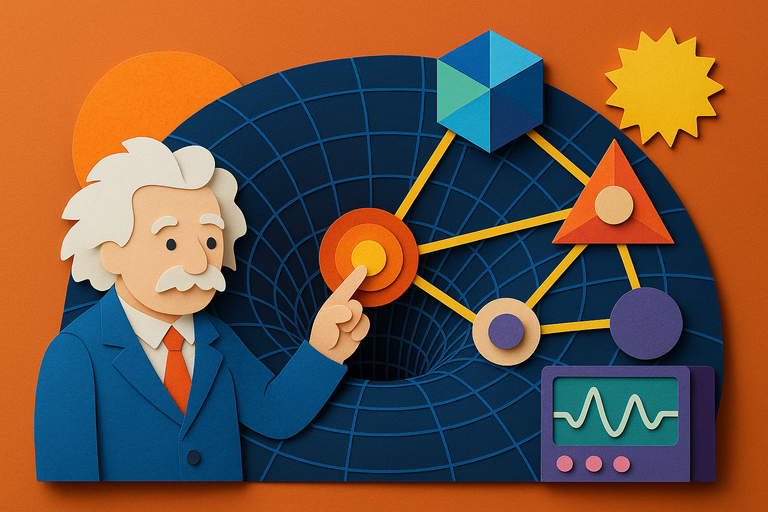
Quantum networks, once thought to be the realm of ultra-secure communications, are now shedding light on fundamental physics mysteries. A team of researchers has shown how these networks can probe the intersection of Einstein's General Theory of Relativity and quantum mechanics, potentially paving the way for a unified theory of quantum gravity.
"The interplay between quantum theory and gravity is one of the most challenging problems in physics today, but also fascinating," says Igor Pikovski from Stevens Institute of Technology. "Quantum networks will help us test this interplay for the first time in experiments."
The team's protocol demonstrates how quantum effects can be distributed across network nodes using entangled W-states, allowing scientists to test quantum theory in curved space-time. This groundbreaking approach could answer whether gravity alters the effects of quantum mechanics, a question that has long puzzled physicists.
By exploiting modern quantum capabilities, researchers are pushing the boundaries of our understanding, turning quantum networks into powerful tools for exploring the fundamental nature of our universe.
SMRTR provides this summary for quick context. The original article belongs to Interesting Engineering.
Read the original article