
Einstein might have been wrong about black holes
SMRTR summary
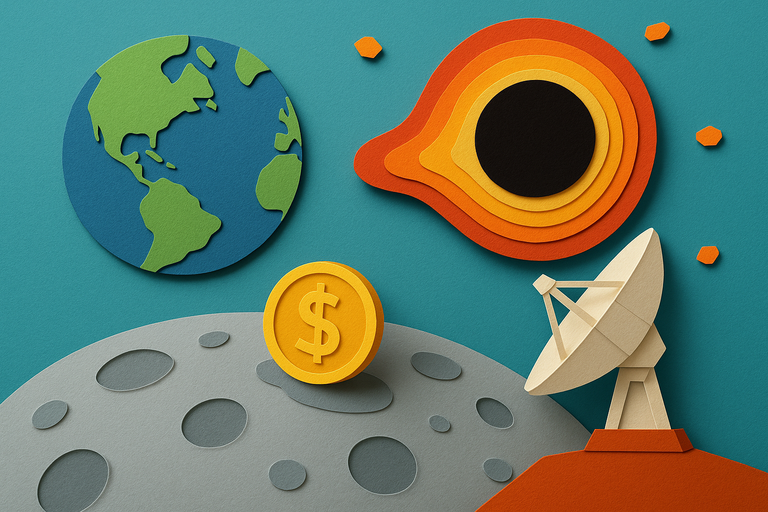
A coin on the Moon's surface, spotted from Earth -- that's the extraordinary precision scientists will need to definitively test whether Einstein's theory of relativity truly describes black holes.
Those stunning images of supermassive black holes captured by the Event Horizon Telescope aren't actually the black holes themselves, but the glowing matter swirling around them before being devoured. "What you see on these images is not the black hole itself, but rather the hot matter in its immediate vicinity," explains Professor Luciano Rezzolla of Goethe University Frankfurt.
Now his team has developed a framework to use these cosmic shadows as testing grounds for competing theories of gravity. Using advanced computer simulations, they've mapped how different theoretical black holes would appear compared to Einstein's predictions.
The current telescope resolution can't yet detect these subtle differences, but upgrades are coming. Scientists plan to add more observatories to the Earth-spanning network and eventually launch a space-based radio telescope.
For now, Einstein's century-old theory continues to hold strong, though some exotic alternatives like naked singularities and wormholes have been ruled out in our galaxy's center.
SMRTR provides this summary for quick context. The original article belongs to Science Daily.
Read the original article