
Building materials are getting closer to doubling as batteries
SMRTR summary
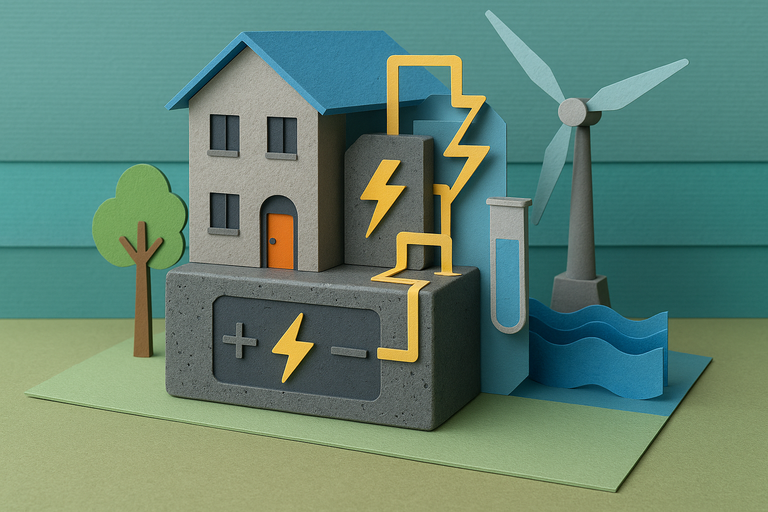
About five cubic meters of concrete—roughly the size of a basement wall—could soon power your entire home for a day. MIT researchers have dramatically boosted the energy storage capacity of their revolutionary "electron-conducting carbon concrete," or ec3, by an order of magnitude. This isn't your ordinary sidewalk material: by mixing cement with ultra-fine carbon black and electrolytes, the team creates a conductive network that transforms structural elements into massive batteries. The breakthrough came through high-resolution 3D imaging that revealed how the carbon network interacts with electrolytes, leading to optimized formulations and thicker energy-storing electrodes. Perhaps most intriguingly, seawater works as an electrolyte, opening possibilities for offshore wind farm foundations that double as power storage. "We found that there is a wide range of electrolytes that could be viable candidates for ec3," says research scientist Damian Stefaniuk. "This even includes seawater, which could make this a good material for use in coastal and marine applications." While the concrete can't match traditional batteries for energy density, it offers something unprecedented: walls, bridges, and sidewalks that store power for decades.
SMRTR provides this summary for quick context. The original article belongs to Daily.dev.
Read the original article