
Are prime numbers hiding inside black holes?
SMRTR summary
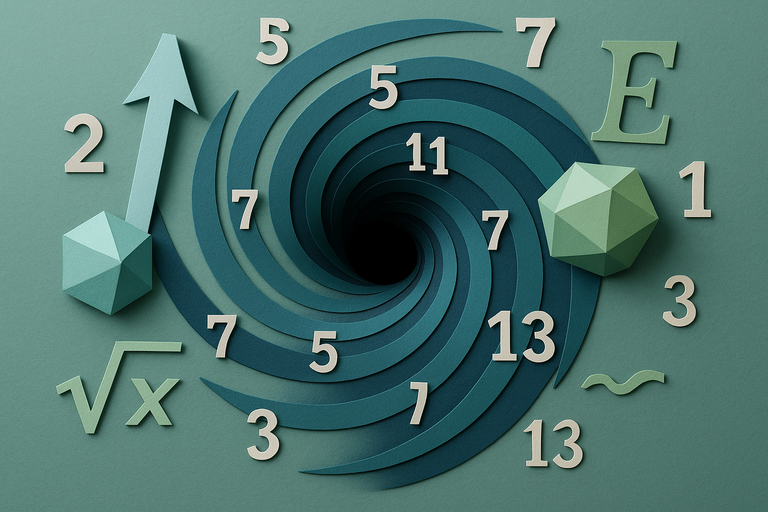
Deep inside black holes, where gravity becomes so intense that space and time themselves break down, physicists have discovered something unexpected: the mathematical chaos swirling near these cosmic monsters follows the same patterns as prime numbers, those fundamental building blocks that can only be divided by themselves and one.
The connection traces back to an 1859 conjecture by German mathematician Bernhard Riemann, whose formula for counting prime numbers includes a mysterious function whose "zeros" have puzzled mathematicians for over 160 years. In the 1980s, French physicist Bernard Julia imagined hypothetical particles called "primons" with energy levels based on prime numbers, but most dismissed this as pure theory.
That changed in 2025 when Cambridge physicist Sean Hartnoll found that the chaotic region just outside a black hole's singularity contains the same scaling symmetries found in Riemann's work. Near these gravitational monsters, quantum systems organize themselves according to prime number patterns.
"We don't know yet whether the appearance of prime number randomness close to a singularity has a deeper meaning," Hartnoll says. "However, to my mind, it is very intriguing that the connection extends to higher dimensional theories of gravity."
The discovery suggests that prime numbers, long considered purely abstract mathematical objects, might actually encode fundamental laws governing the universe's most extreme environments.
SMRTR provides this summary for quick context. The original article belongs to Scientific American.
Read the original article