
Train a Humanoid Robot with AI and Python
SMRTR summary
Four-legged robots stumble through virtual worlds, crashing into walls and toppling over thousands of times per second. But that's exactly the point.
Training humanoid robots in the real world costs a fortune and takes forever. So engineers are turning to sophisticated 3D simulators where robots can fail spectacularly without breaking expensive hardware. These digital training grounds can run thousands of scenarios simultaneously, teaching machines through trial and error at superhuman speeds.
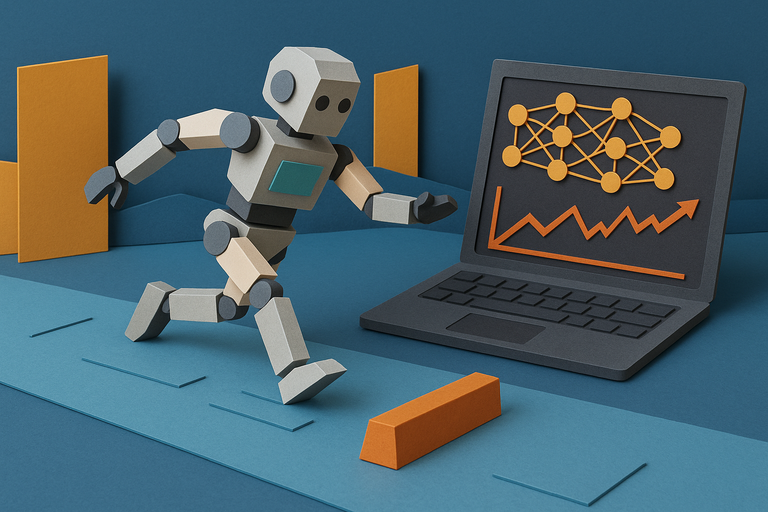
The process relies on reinforcement learning, where robots receive rewards for successful actions and penalties for failures. A humanoid robot might get positive points for staying upright or moving forward, but lose points when it face-plants into the ground.
The magic happens when simple reward systems meet deep neural networks. Using algorithms like Proximal Policy Optimization, robots learn complex behaviors without being explicitly programmed for each movement. Train a humanoid long enough in simulation, and it progresses from constantly falling to eventually walking forward.
This "sim-to-real" approach is reshaping robotics development, with billions of humanoid robots predicted by 2050.
SMRTR provides this summary for quick context. The original article belongs to Daily.dev.
Read the original article