
A Very Subjective History of Functional Programming
SMRTR summary
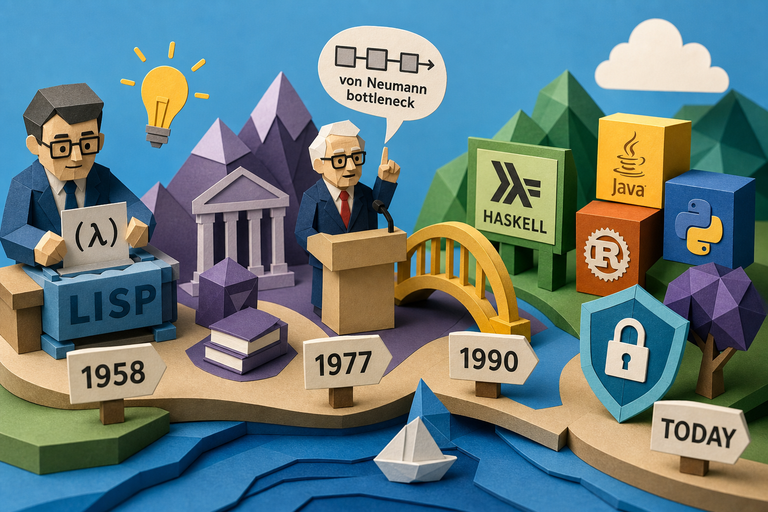
A simple math problem changed programming history. In 1958, engineer John McCarthy needed software that could handle symbolic algebra, not just crunch numbers. No language could do it. So he built one: LISP, which accidentally gave birth to functional programming.
Decades of academic research followed, mathematicians discovering that programs were elegant mathematical objects. Then, in 1977, John Backus, the very creator of Fortran, accepted a Turing Award and stunned the computing world by declaring imperative programming a dead end, coining the phrase "von Neumann bottleneck."
By 1990, those ideas crystallized into Haskell, a landmark language built by a rare academic committee actually willing to cooperate.
Today, the revolution is invisible but everywhere. Lambdas in Java, list comprehensions in Python, immutability in Rust: all trace back to that original McCarthy problem. When multi-core processors made shared mutable data genuinely dangerous, functional programming stopped being academic elegance and became practical engineering wisdom.
The ideas won quietly, without anyone declaring victory.
SMRTR provides this summary for quick context. The original article belongs to Hacker Noon.
Read the original article