
Lab-grown brain tissue successfully solves a classic AI training problem
SMRTR summary
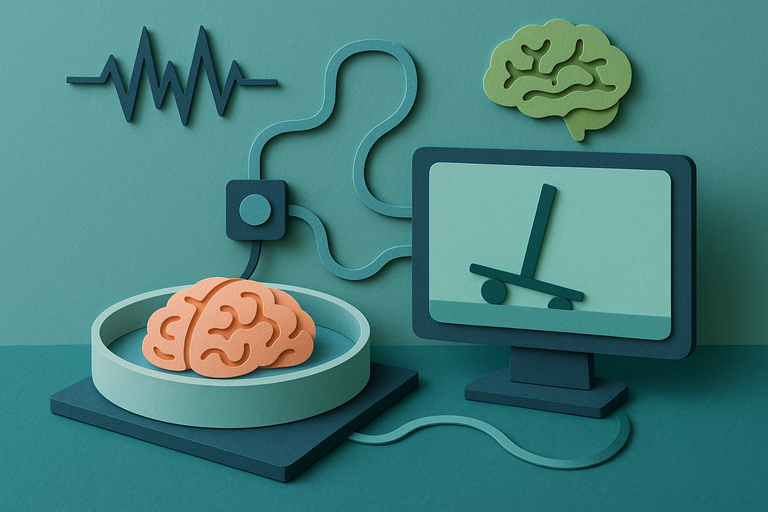
Mouse brain cells floating in a lab dish have learned to balance a virtual pole on a cart, mastering a classic robotics challenge that typically requires computer algorithms. Researchers at UC Santa Cruz connected clusters of living neural tissue called cortical organoids to a digital simulation, creating a feedback loop where the brain cells' electrical activity controlled a wobbling pole that needed to stay upright.
The experiment used adaptive feedback to "coach" the neural circuits, sending targeted electrical pulses when performance declined. Organoids receiving this training achieved successful control in 46 percent of test cycles, more than ten times better than those getting random or no feedback.
"When we can actively choose training stimuli, we can actually shape the network to solve the problem," said researcher Ash Robbins. The biological controllers showed genuine learning, but their skills faded after 45 minutes of inactivity, suggesting the tissue lacks mechanisms for long-term memory.
The work aims to understand how neural systems adapt and reorganize, potentially advancing treatment for neurodegenerative diseases rather than replacing traditional computers with lab-grown brain tissue.
SMRTR provides this summary for quick context. The original article belongs to TechSpot.
Read the original article