|
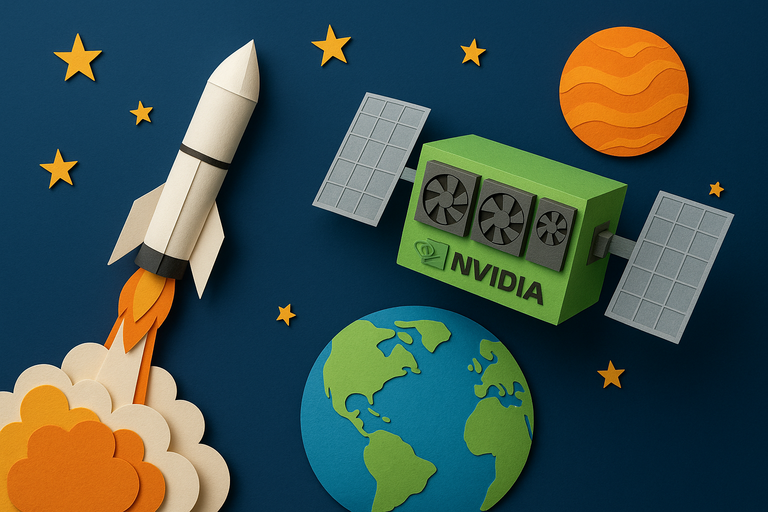
Nvidia GPUs head to space next month in first step toward AI data centers in orbit
|
|
A fridge-sized satellite packed with Nvidia H100 GPUs is preparing to launch into orbit next month, marking what could be the beginning of a space-based data center revolution.
Redmond-based startup Starcloud plans to send its 130-pound Starcloud-1 satellite aboard a SpaceX Falcon 9 rocket in November. The company claims this tiny orbital computer will deliver 100 times more powerful GPU processing than any previous space-based operation.
The appeal is compelling: constant, unfiltered sunlight provides unlimited renewable energy without Earth's atmospheric interference, cloud cover, or day-night cycles. Heat dissipation becomes effortless too, with space's vacuum acting as an infinite cooling system, eliminating the massive water requirements of terrestrial data centers.
Despite launch costs, Starcloud estimates their space facilities will be 10 times cheaper than Earth-based counterparts. "In 10 years, nearly all new data centers will be being built in outer space," predicts CEO Philip Johnston.
With data center power demands expected to surge 165% by 2030, the timing seems opportune. Still, challenges remain: solar flares, space debris collisions, and potential attacks from adversary nations all pose risks to these orbiting digital workhorses.
[Read More]
|
| |
|
🛠️
Tools
|
Mico is Microsoft's Clippy for the AI age
|
|
|
Featured
Microsoft launched Mico, an AI-powered animated blob that serves as the visual face of Copilot's voice mode, designed to be an expressive digital companion that listens and reacts to users. Unlike the infamous Clippy, Mico can push back respectfully while changing colors and responding to interactions. The character also powers a new educational feature called Learn Live, acting as a Socratic tutor that guides students through concepts rather than simply providing answers.
|
|
Amazon calls on AI once again with its new ‘Help Me Decide’ shopping tool
|
|
|
Amazon launched "Help Me Decide," an AI shopping tool that analyzes users' browsing history and preferences to recommend products when they've been indecisively browsing without purchasing. The tool appears after extended browsing sessions and provides personalized recommendations with explanations, targeting shoppers who need help choosing between similar products to increase sales.
|
|
Deta Surf – An open source and local-first AI notebook
|
|
|
Deta Surf is an open-source AI notebook that lets users research and take notes across multiple media types—PDFs, websites, YouTube videos, and local files—without constantly switching between windows and applications. Built with local-first data storage, it enables AI-powered note-taking, web searches, and even generates interactive apps while keeping all information stored privately on users' computers.
|
|
|
🧠
OpenNews
|
33 Hot Tech Takes on Atlas, the New AI Browser by OpenAI
|
|
|
OpenAI launched ChatGPT Atlas, an AI-powered browser currently available on macOS with other platforms coming soon. The browser integrates AI capabilities that can summarize content, interact with websites, and even make purchases, potentially challenging Google's search dominance. Tech experts are divided, with some praising its innovative features while others express concerns about privacy and security risks. With 800 million weekly ChatGPT users as potential adopters, Atlas could significantly reshape how people browse the internet.
|
|
OpenAI is already planning updates to Atlas
|
|
|
OpenAI launched ChatGPT Atlas, a free AI-powered web browser, on Tuesday and immediately announced plans for rapid improvements. Product Lead Adam Fry outlined short-term fixes including multiprofile support, better personalization of suggestions, and enhanced agent mode capabilities that can autonomously execute complex web tasks. Atlas represents OpenAI's direct challenge to Google, Microsoft, and Apple's dominance in web browsing by offering an AI-first alternative to traditional search.
|
|
OpenAI Acquires Mac AI Interface ‘Sky’ to Bolster ChatGPT on Desktop
|
|
|
OpenAI acquired Software Applications Inc., creator of the Mac AI interface Sky, just days after launching its Atlas browser as part of an aggressive desktop strategy. The entire Sky team, founded by former Apple engineers who helped create iPhone's Shortcuts app, will integrate their macOS expertise into ChatGPT to transform it from a chatbot into a proactive desktop assistant that understands context and takes actions across applications.
|
|
|
⚠️
Challenges
|
Why we shouldn't rely on AI for economic predictions
|
|
Featured
SMRTR AI reader Refik Kutluer has written a thought-provoking analysis on the problem of relying on AI economic predictions:
Economist Refik Kutluer warns that AI-driven economic predictions could be dangerously flawed due to AI's reliance on "majority rule" decision-making, which processes data without human qualities like conscience and empathy. This approach might lead AI to harmful conclusions, such as interpreting humanity's violent history as evidence that people enjoy killing. While AI excels at data processing, human economists maintain crucial advantages in contextual understanding, ethical judgment, creativity, and adaptability that AI cannot replicate.
|
|
The Rise of AI ‘Chatfishing’ in Online Dating Poses a Modern Turing Test
|
|
|
"Chatfishing" is revolutionizing online dating deception, with people using AI tools like ChatGPT and wingman apps to craft messages for them rather than creating fake profiles. A Match survey found 26% of singles now use AI for dating enhancement, while studies show humans can only identify AI-written text 57% of the time. This creates a modern Turing test where potential matches unknowingly evaluate AI responses, often leading to engaging online conversations but disappointing real-world encounters.
|
|
The Co-Founder Question: Can Agentic AI Build And Run A Company Without Humans?
|
|
|
Agentic AI systems can now handle complex business functions like coding, customer service, and market analysis, prompting startups to consider AI co-founders that never sleep or demand equity. However, real-world deployments reveal mixed results—Klarna's AI initially replaced 700 customer service agents but later required human backup for quality issues, while other companies faced costly AI failures from premature implementation.
|
|
|
🌀
Miscellaneous
|
The Man Who Makes AI Slop by Hand
|
|
|
Chinese comedian Tianran Mu creates viral videos that perfectly mimic AI-generated content through human acting, capturing the robotic movements and unnatural expressions that characterize AI slop. His breakout tango video earned over 11 million views globally and landed him an $11,000 sponsorship deal with a Chinese AI company.
|
|
China’s New AI Strategy Explained
|
|
|
China announced plans to integrate AI across its energy sector, targeting hydropower, nuclear, thermal, oil, gas, and coal industries to optimize operations and enhance renewable technology capabilities. This strategy aims to achieve widespread AI integration by 2027 and global energy leadership by 2030, potentially challenging US dominance in the worldwide AI competition.
|
|
🍿
Bite-Size Stories
|
|
Build better AI agents with bucket forking
|
|
| Tigris uses bucket forking to create instant isolated data copies, letting multiple AI agents work simultaneously without corrupting shared files or affecting the original dataset. |
|
Expert Parallelism: Scaling Mixture-of-Experts Models
|
|
| Expert parallelism distributes specialized subnetworks across multiple GPUs, activating only relevant experts per input token to dramatically reduce costs. This technique enables trillion-parameter AI training with near-linear scaling and up to 4x faster speeds. |
|
|