|
From AI art to body scans: Midjourney unveils underwater body scanner
|
|
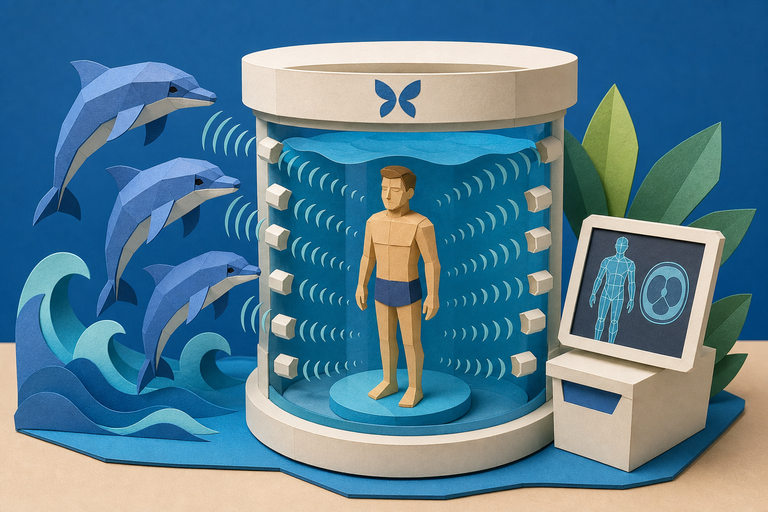
Half a million tiny elements, each the size of a grain of sand, firing ultrasonic waves from every angle. That's the technology behind the Midjourney Scanner, a surprising new venture from the AI image company best known for turning text into art.
The device works by slowly submerging you in water while a ring of ultrasonic sensors maps your entire body in under 60 seconds, producing 3D imaging comparable to an MRI but nearly a hundred times faster.
Midjourney is building the scanner in partnership with Butterfly Network, an ultrasound device maker. The plan is to debut at a San Francisco spa, pursue FDA approval, then expand to other cities by 2028, with an ambitious goal of 50,000 units worldwide by 2031.
It's an unusual pivot for an AI company, but the technology is striking. As Midjourney puts it, the experience is like being surrounded by half a million tiny dolphins, all using echolocation at once.
[Read More]
|
| |
|
🕹️
Retro Tech
|
Connecting Peripherals to Atari 8-bit Computers
|
|
|
Early Atari 8-bit computers used a proprietary SIO port, making it impossible to connect standard printers or modems without an expensive $200 interface box called the Atari 850. Third-party printer interfaces offered cheaper alternatives, and ICD later released the advanced MIO Board, which added hard drive support.
|
|
Super Mario 64 Port Brings Local Multiplayer to the Original Nintendo DS
|
|
|
A developer named Tobi Friedly has ported Super Mario 64 to the original Nintendo DS, complete with local two-player co-op. By using NitroFS streaming to work around the DS's tiny 4MB RAM, the full 120-star game runs smoothly, letting two players explore stages together on linked handhelds simultaneously.
|
|
Guide to the TD4 4-bit DIY CPU
|
|
|
Featured
The TD4 is a tiny 4-bit DIY CPU kit from AliExpress that teaches core computer architecture concepts through hands-on building and programming. It features just two registers, 16 bytes of program ROM made from physical dip switches, and a small instruction set including ADD, MOV, JMP, and JNC. Despite its limitations, the kit can run programs like counting sequences and blinking LEDs, making it a practical introduction to how CPUs actually work at the hardware level.
|
|
|
🤖
AI & Robots
|
Who's Actually Running That Robot?
|
|
|
Despite flashy demo videos showing robots folding laundry or playing sports, most humanoid robots are far less independent than advertised — many are secretly controlled by humans using VR headsets, with engineers constantly fixing breakdowns behind the scenes. This hidden labor goes unrecognized while machines get the credit. The real risk isn't mass unemployment but a growing class of underpaid, invisible workers supporting these systems.
|
|
The Inventor of the Thinking Machine Didn’t Worry. Neither Should You
|
|
|
Philosophers Blaise Pascal and Martin Buber offer reassurance that AI won't replace us as humans. Pascal argued machines lack "heart," while Buber distinguished between genuine human connection and mere interaction with objects. AI-generated music or art may sound real, but without a human behind it, there's no true personal encounter.
|
|
Can Snap Survive the Wearable Graveyard Google Built?
|
|
|
Snap launched its AR glasses priced at $2,100, sending its stock down 5%. Despite billions invested across Google, Meta, Microsoft, and others, smart glasses have repeatedly failed to beat smartphones. Whoever cracks wearable computing could control the next era of software, ads, and commerce.
|
|
❤️ Enjoy reading SMRTR Tech?
Click here to share with your friends and family.
|
💻
Tech Updates
|
Mobile small reactors on ships: UK firm explores floating nuclear power plants
|
|
|
UK-based Core Power is studying whether small modular reactors can be mounted on ships to create floating nuclear power plants. Using BWX Technologies' mPower reactor, these vessels could generate 195 megawatts of electricity and be towed to coastal cities or remote areas facing energy shortages, bypassing lengthy land-based construction delays.
|
|
Microsoft and Adobe team up and make Photoshop 20% faster on Windows
|
|
|
Microsoft and Adobe teamed up to make Photoshop run faster on Windows by improving how the software is compiled. By combining MSVC's peak-performance mode with a newer optimization technique called SPGO, engineers boosted Photoshop's speed by 20% on x64 Windows and 13% on Arm. Users will notice faster brush responsiveness, quicker file-opening times, and smoother filter processing — key tasks in professional creative work.
|
|
|
🌀
Miscellaneous
|
US quantum computer demonstrates 99.9975% fidelity, paves the way for a fault-tolerant future
|
|
|
Featured
Quantinuum's Helios quantum computer has achieved record-breaking 99.9975% fidelity in one-qubit operations, the highest for any commercial quantum computer. The 98-qubit system uses trapped-ion technology combined with photonics, consuming just 40kW of power. Quantinuum is partnering with Sandia National Laboratories to advance fault-tolerant quantum computing.
|
|
MapTap, a daily geography game, is my new Wordle
|
|
|
MapTap is a free daily geography game (available as an app and on the web) that's winning over fans of Wordle-style puzzles. Players are given five locations to find on a map, earning up to 1,000 points based on accuracy, with questions getting harder as the game progresses. Unlike similar geography games, MapTap lets you guess even when stumped, and teaches players about each location afterward.
|
|
🍿
Bite-Size Stories
|
|
Apple opens up third-party app stores in Brazil
|
|
| Apple is expanding third-party app store access to Brazil, following similar regulatory-driven changes in Europe, giving iOS users the ability to download apps outside the official App Store. |
|
|